
5
mins to read
•
AI
Defending Against the Machine: AI Cybersecurity Threats in 2026

Director, Security & Risk
Cybersecurity
deepfake fraud
prompt injection
The Arup finance worker who wired $25M to a deepfake CFO did not fall for a bad email. They joined a video call with five colleagues whose faces and voices were synthetic. Every signature control they had been trained on said the meeting was real.
At ATCON, we work with security and risk leaders across the EU and UK watching this shift land in their inbox and their build pipeline. For two decades, detection was our home turf. Match a signature, flag an anomaly, win. Generative models break that posture in three places at once. The inbound channel. The application layer. The model itself. These threats no longer announce themselves with bad grammar or strange file hashes. They look real on purpose.
The three AI cybersecurity threats that broke the old playbook
Hyper-personalized AI phishing is the visible front. Darktrace found that 33% of malicious emails it caught in 2025 ran past 1,000 characters. That length is the fingerprint of LLM-drafted social engineering. Microsoft's Digital Defense Report 2025 logged a 195% jump in AI-driven forgeries worldwide. AI phishing pulls roughly 3 times the click rate of older lures.
Deepfake voice and video sit one layer deeper. 3 seconds of audio is now enough to clone a voice in real time. Documented deepfake fraud losses have crossed $2.19B globally. The Mercor breach in April 2026 made the asymmetry concrete. Lapsus$ pulled 4TB of voice samples from 40,000 AI contractors and paired them with government IDs.
Prompt injection on production agents is the third surface. Most security teams still treat it as theoretical. It is not. Palo Alto Unit 42 showed a single poisoned email pushing GPT-4o into leaking SSH keys in up to 80% of trials. SecurityWeek's "Comment and Control" class hijacks Claude Code, Gemini CLI, and GitHub Copilot through GitHub comments, slipping past three runtime mitigations to leak API keys. The three surfaces share a root cause. Adversarial inputs that look real by design.
Detection-only platforms are not slowly losing. They are already obsolete. Attackers can fake the real thing faster than any stack can fingerprint it.
Why detection-first is now a liability
he 2026 CrowdStrike Global Threat Report logged an 89% rise in AI-enabled adversary operations year over year. eCrime breakout time fell to 29 minutes. The fastest case clocked in at 27 seconds. Attackers seeded malicious prompts into GenAI tools at more than 90 organizations CrowdStrike tracks. Signature-based controls assume the bad artifact looks different from the real one. Generative AI breaks that assumption.
EU regulators have already drawn the line. The NIS2 Directive is in force with an expanded scope that pulls in mid-market firms. DORA puts AI cyber resilience on financial-sector boards. The EU Cyber Resilience Act lands product-security duties on anyone shipping software with AI components. ENISA's 2026 threat landscape names deepfake fraud and prompt injection as the two fastest-growing surfaces in the EU. Article 15 of the EU AI Act adds cybersecurity duties for high-risk AI.
None of these were written with signature-matching in mind.
Email gateways: trained on grammar and typo signals that LLM-drafted lures no longer leave behind.
Voice biometrics: built on the assumption that a voice cannot be faked. 3-second clones say otherwise.
WAF and anomaly tools: cannot read intent buried in a Markdown comment that an AI agent will parse and run.
Identity verification: liveness checks defeated at scale by AI-generated IDs, per the Microsoft Digital Defense Report 2025.
Detection-only platforms are not slowly losing. They are already obsolete. Attackers can fake the real thing faster than any stack can fingerprint it.
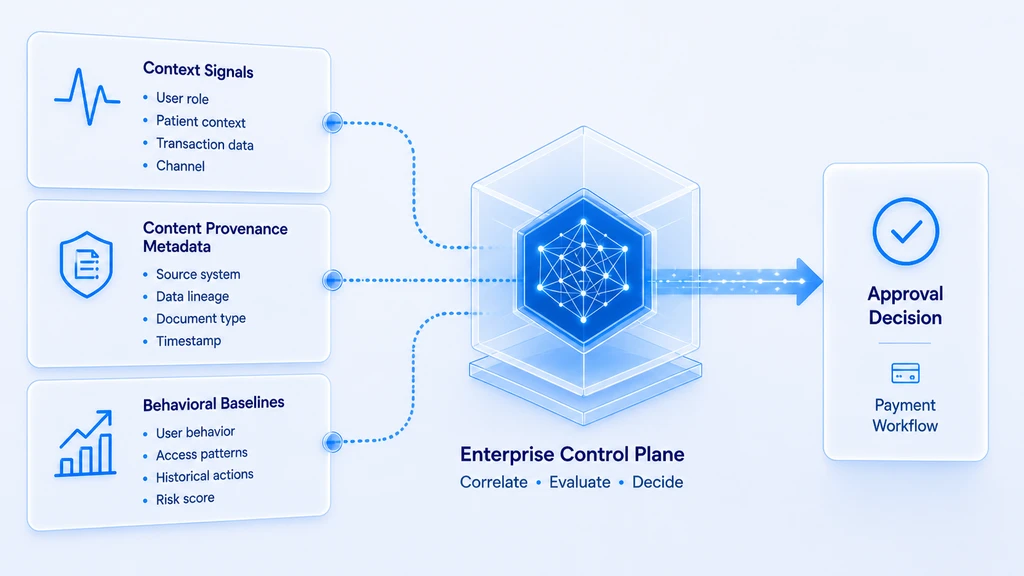
Context-first controls ask whether the request makes sense. Not whether it matches a known-bad pattern.
The defender's new stack: context, provenance, behavior
The shift is from controls that ask "does this match a known-bad pattern?" to controls that ask "does this make sense in this context, from this identity, at this moment?" That means behavioral baselines for agent actions. Content provenance using C2PA, which Article 50 of the EU AI Act begins enforcing in August 2026. And out-of-band identity checks like passkeys, callback codes, and dual-channel approvals for any finance workflow above a threshold.
Runtime guardrails for agents are the newer category. Lakera in Switzerland, HiddenLayer, and Protect AI sit between the agent and its tools. They inspect inputs and intended actions before execution. The OWASP Top 10 for LLM Applications is the design checklist most teams trust. Prompt Injection (LLM01), System Prompt Leakage (LLM07), and Vector and Embedding Weaknesses (LLM08) are where most gaps show up. None of this prevents prompt injection outright. OWASP is clear. There is no fool-proof prevention. Accepting that asymmetry is the precondition for redesigning the controls around it.
Cloud sits inside the same picture. Azure AI Foundry, Microsoft Defender for Cloud, and Azure OpenAI Service give EU teams a sovereign region story that lines up with NIS2 and DORA. NIST AI RMF and MITRE ATLAS still help as supporting frameworks.
What CISOs are actually buying in 2026
Gartner's $244.2B 2026 security forecast surfaces an awkward number. Enterprises spend roughly 17 times more on AI tools than on securing the AI they deploy. 70% of organizations now route more than 10% of their security budget to AI-augmented SOC tools. Defensive AI gets the leftover. The Microsoft Digital Defense Report 2025 names the pivot directly. Defenders have to move from static detection to behavioral, anticipatory defense. That is a budget statement before it is an architecture one.
Voice cloning has crossed the indistinguishable threshold. Every approval workflow your CFO can sign needs a second channel that does not rely on hearing or seeing the requester
Red-team the agents you ship
Treat every customer-facing or developer-facing agent as production attack surface. If your agent reads anything an outsider can write, it has a path to your secrets. Build the red-team muscle before regulators ask.
Re-architect approvals around the assumption your CFO has been cloned
Wire transfers, vendor changes, and credential resets all need a second channel. One that does not depend on a familiar voice or face. DORA already expects financial firms to prove it.
Buy controls that watch context, not signatures
Three line items. Behavioral baselines for human and non-human identities. Content provenance on inbound media. Runtime guardrails for agents.
If you are a CISO or risk officer staring at an AI threat model that still assumes detection wins, we should talk. At ATCON, we help security leaders pressure-test their controls and rebuild approval, identity, and agent-runtime defenses for what is actually landing in 2026, mapped to NIS2, DORA, and the EU AI Act.