
5
mins to read
•
AI
Beyond the Chatbot: Agentic AI in Healthcare's Patient Journey

Principal, Care Delivery Innovation
Healthcare
agentic AI
patient intake
The first useful AI agent inside a hospital did not read a chart or suggest a diagnosis. It called 12 insurance plans, verified eligibility, and started a prior authorization while the front desk finished their coffee.
At ATCON, we sit with CMIOs and COOs across the NHS, AP-HP Paris, Charité Berlin, and large US systems. For two years, the healthcare AI conversation has been stuck on diagnosis. Meanwhile, agentic AI has gone live in the boring middle of the patient journey. Intake. Scheduling. Prior auth. Scribing. Coding. Discharge follow-up. That is where the early money is being made.
The real bill: where 25 cents of every healthcare dollar goes
About a quarter of US healthcare spend is administrative, close to $1T a year. McKinsey put the addressable slice at $265B. The American Hospital Association reported hospitals spent $43B in 2025 chasing payments they had already earned. NHS England spends an estimated £14B a year on non-clinical admin. Karolinska Institutet and Gemelli Rome show clinicians lose 2 to 3 hours a day to paperwork. The bill is not only American.
That is the prize. Not a marginal lift in radiology accuracy. Not a smarter triage chatbot. The prize is the clerical tail between a patient arriving and the claim clearing.
Healthcare's first useful agents are not diagnosing disease. They are doing the boring, billable, regulated work that no clinician went to medical school to do.
From chatbot to coworker: what makes an agent agentic
he earlier chatbot wave was scripted. It answered FAQs and routed calls. An agent is different. It is multi-step. It uses tools. It carries memory across systems. It can act inside the EHR and the payer portal, not just hand off to a human who will.
That distinction is now visible in production. Hippocratic AI says its voice agents have handled more than 150M clinical interactions across 50 plus partners. Innovaccer's Gravity platform is live at Kaiser, Ascension, Trinity, and Banner. In Europe, Doctolib is rolling out agentic patient access flows for clinics in France and Germany on Azure regions in Frankfurt and Paris. Abridge has moved from passive scribe to active assistant. These are no longer pilots on a single floor.
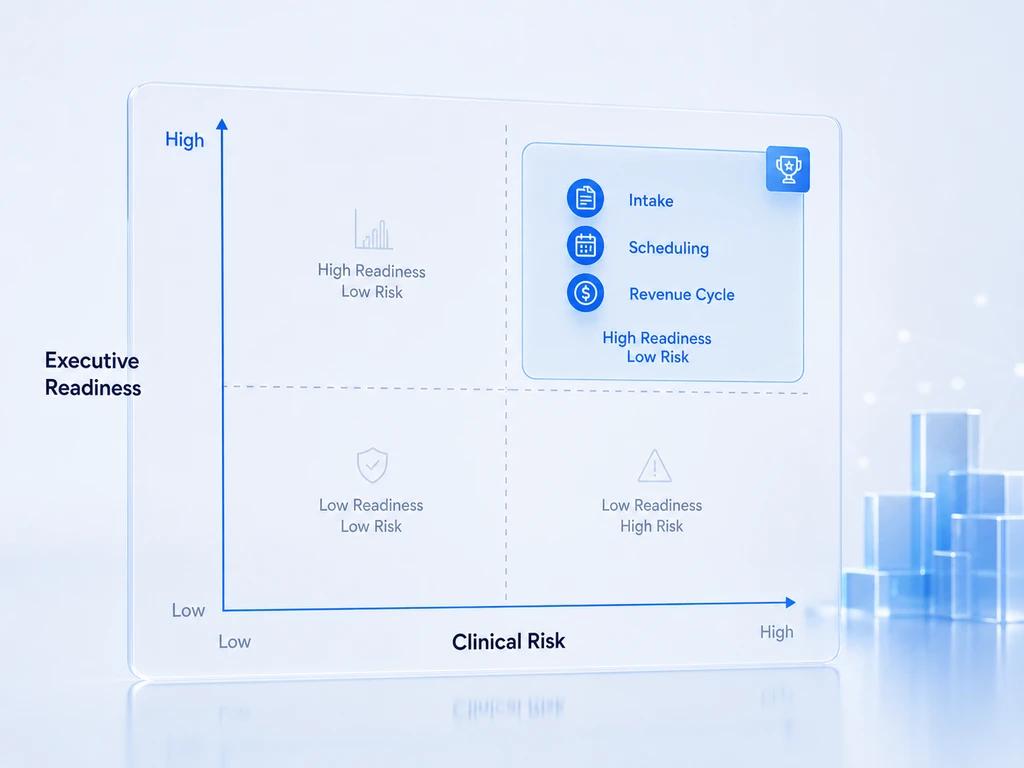
Executive readiness is highest exactly where clinical risk is lowest. That is why the admin layer ships first.
Intake to discharge: 5 workflows already live
The real ROI today sits in a handful of repeatable patterns. Each one targets a workflow with high volume, structured artifacts, and a clean audit trail.
Pre-registration and eligibility: agents call payers, verify benefits, flag coverage gaps, and pre-fill the registration packet before the patient arrives. Notable and Assort report intake-time reductions north of 40%.
Prior authorization: Risant Health cut prior auth from 45 min to under 1 min using Innovaccer's agent stack. R1 RCM clears 68% of prior auths within an hour and 97% within a day.
Ambient documentation and coding: Sharp HealthCare, MaineHealth, and others using Abridge report a 38% drop in note time, an 18% lift in patients seen at Samaritan, and a 7.8% wRVU lift at one large system. Suki and Abridge show roughly $1,000 to $1,200 per provider per month in extra captured revenue.
Denials defense: coding-related denials are up about 120% year over year. That is pushing systems toward agents that audit claims before submission.
Discharge and post-discharge: voice agents handle medication reconciliation, follow-up scheduling, and symptom check-ins. Early adopters see readmission cuts in the low 20% range.
What will slow this down
The honest counterweight to the ROI story is governance. In Europe, the rules came first and they bind hardest. The EU AI Act classes most clinical-decision agents as high-risk systems. EU MDR covers any agent that influences a treatment decision. GDPR sets the floor for every byte of patient data the agent reads or writes. EHDS, the European Health Data Space, is reshaping cross-border data flows. In the US, the 2025 HIPAA Security Rule amendments now apply directly to agentic architectures.
The dominant new failure mode is what compliance teams call silent failure. An agent that looks right and reasons wrong, often for weeks before anyone notices. Kaiser's $556M Medicare Advantage settlement and Cigna's PxDx system, which spent about 1.2 seconds per claim review, show what algorithmic admin looks like when nobody audits the logic.
Deloitte's latest survey contains the kicker. Only 3% of US health systems have agents in live workflows. 61% are building or have funded initiatives. 85% plan to grow investment over the next 2 to 3 years. The gap between pilot and production is where governance has to catch up.
An agent that quietly miscodes, mis-authorizes, or mis-bills at scale is a regulatory event waiting to happen.
The PHI surface area problem
Map every place an agent can read or write PHI before you scale. Under GDPR, EHDS, and the 2025 HIPAA amendments, the agent is a covered actor, not a tool. Logging, access boundaries, and incident response need to be designed before the first vendor SOW is signed. Not after the first audit.
What boards should ask in 2026
Three questions separate deployments worth funding from pilots worth killing. What workflow does this agent own end to end, and what is the dollar value? What is the silent-failure detection plan, and who reads the agent's work against what baseline? When the agent is wrong, who is accountable on the org chart, by name? The systems that answer cleanly are the ones whose 2027 admin cost curve will bend.
If you are sizing an agentic AI program for 2026, or deciding which pilots deserve another budget cycle, we run working sessions with health system COOs and CMIOs on exactly this. Bring your top three workflows. We will pressure-test the economics together.