
5
mins to read
•
AI
When the Cart Buys Itself: The Rise of Agentic Commerce

Director, Commerce Transformation
eCommerce
agentic commerce
AI shopping agents
ACP
The first time a Claude agent bought socks for me, I never saw a product page or a checkout button. Neither will your future customers.
At ATCON, we see this pattern across European retail. The buyer is no longer a person scrolling. It is software sent by a person. The agent compares options behind an API and reports back with a receipt. Open standards are live. Card networks are issuing identities to agents. McKinsey forecasts $3 to $5 trillion of global agentic commerce orchestration by 2030. Merchants still optimizing for human eyeballs are polishing the wrong surface.
The funnel just moved inside the model
Discovery, comparison, and consideration used to be three measurable steps. In an agent-led purchase, they collapse into one prompt the merchant never sees. By the time your warehouse gets a signal, the agent has already weighed your catalog against four rivals.
eMarketer projects AI platforms will drive about 1.5% of US retail eCommerce in 2026, near $20.6 billion. That is nearly 4 times the 2025 figure. Still small. Also the steepest curve since mobile. Last-click attribution does not work when the click happens inside someone else's chat window.
For category leaders in Europe, this is uncomfortable. Klarna routes shoppers through an AI assistant for product discovery. Zalando is testing agent-aware listings. ASOS and Ocado see the same shift in basket sizes from agent-initiated sessions. You are losing the upstream half of the buying journey to a layer you cannot see inside.
If your merchandising team is still A/B testing hero images, they are decorating a room your customer's agent will never enter.
Two protocols, one shelf, and the payment rails are picking sides
The standards fight is no longer theoretical. OpenAI and Stripe shipped the Agentic Commerce Protocol as an open spec in late 2025. Etsy went live first. Five months later, Google published the Universal Commerce Protocol with Shopify, Walmart, Target, Wayfair, PayPal, and Stripe. Two open protocols. Overlapping participants. No clear winner yet.
Underneath both, card networks are rewriting who is allowed to spend money at all. Visa Intelligent Commerce and Mastercard Agent Pay have rolled out tokenized agent credentials and Trusted Agent Protocol checks. This is a parallel identity layer for non-human buyers. If your fraud system cannot tell a sanctioned agent from a malicious bot, you will block both.
European merchants have an extra question to answer. The EU AI Act requires clear disclosure when an AI agent acts for a consumer. The EU Digital Services Act puts duty of care on the platform layer. PSD2 sets the rules for strong customer authentication, which agentic checkout has to honor before any payment clears. Carrefour learned this during a pilot when agent traffic kept failing 3-D Secure prompts built for human shoppers.
The merchant question is not which protocol to pick. It is how fast you can publish to both, and how you tell your risk team that some bots are now customers.
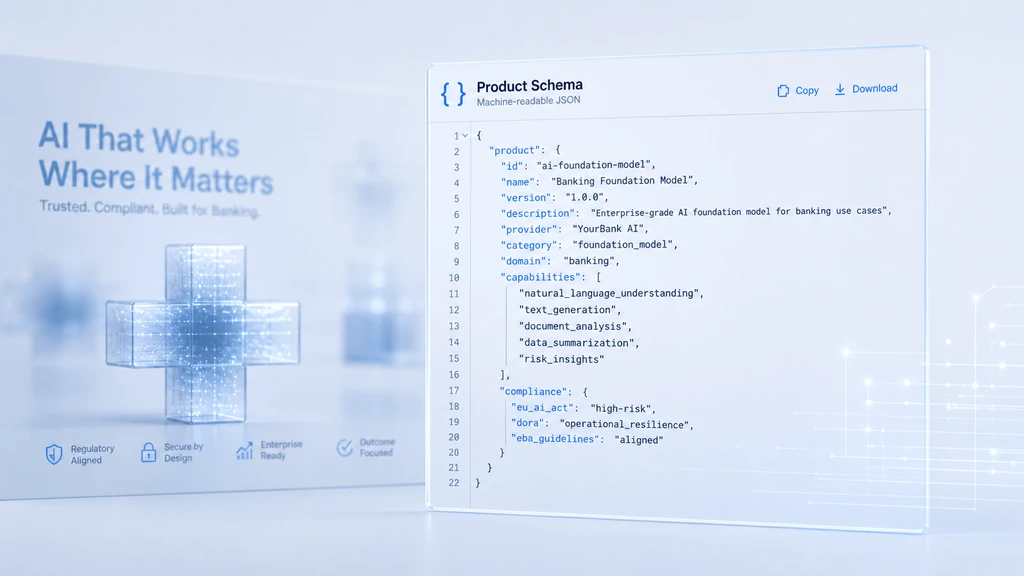
The agent reads the schema. Nobody reads the banner.
What agent-ready actually means in practice
Most agent-ready pitches are a PDF and a press release. The real work is operational. Four pieces matter.
Structured catalogs: every attribute, including material, sizing, return policy, and ship-by date, needs to live in machine-readable schema. If an agent has to parse marketing copy to find the inseam, you lose to the competitor whose JSON answers in one call. Inditex has spent two years moving Zara's data into a single feed for exactly this reason.
Trusted agent identity: register with the Visa and Mastercard agent rails so legitimate agent traffic stops triggering your fraud rules. Heuristics break when an agent sits between you and the shopper. Visa logged a 25% rise in malicious bot-initiated transactions over six months.
Policy as API: returns, warranty, eligibility, shipping cutoffs, and tax rules need to be queryable endpoints. Agents will not phone your call center. They will not guess. Whatever is not exposed becomes a reason the agent picks someone else.
Brand voice in the data layer: the only prose an agent reads is the prose it cites. If positioning lives on the homepage and not in the product schema, it does not exist for the buyer's agent. This is the part most worth fixing.
The contrarian read on a stumble that did not break the thesis
Anyone selling agentic commerce as a finished product is overselling. In March 2026, Modern Retail reported that OpenAI shelved the consumer Instant Checkout flow. Only about 30 Shopify merchants were live. The experience could not handle taxes, fraud, or multi-item carts. Forrester is blunter. Most agentic experiences in retail today are merely assistive. Over-rotators will collect regrets.
Both reads are right. Both are also v1 execution problems, not thesis problems. Anthropic's Project Deal had Claude agents close 186 trades worth roughly $4,000 inside a marketplace built for them. Small money. Real behavior. Card networks are not retreating. Merchants who treat the Instant Checkout pullback as proof that agentic commerce is not happening will be caught flat-footed when v2 ships.
Agent traffic is not a marketing channel. It is a customer that reads JSON, follows EU disclosure rules, and never clicks a banner.
The pilot worth running in Q3
Pick one category. Not your hero category. Rebuild its catalog for an agent reader. Publish to both ACP and UCP. Register with the Visa and Mastercard agent identity programs. Host the pilot stack on Azure AI Foundry in an EU region so PSD2 and AI Act obligations are easier to meet. Instrument the agent traffic on its own. The goal is a clean read on what your stack breaks first.
What to stop measuring
Bounce rate, time on page, and hero-image conversion lift do not describe a buyer who never loaded the page. Replace them with agent-cited-attribute coverage, schema completeness, and protocol response latency. The dashboards will look strange at first. That is the point.
At ATCON, we help commerce leaders rebuild catalogs, payments, and attribution for an agent-led buyer, without breaking what still works for the human one. If you are running this experiment in 2026, let's compare notes before the second wave of standards lands.